Nobody agrees where a moment starts — so we stopped pretending
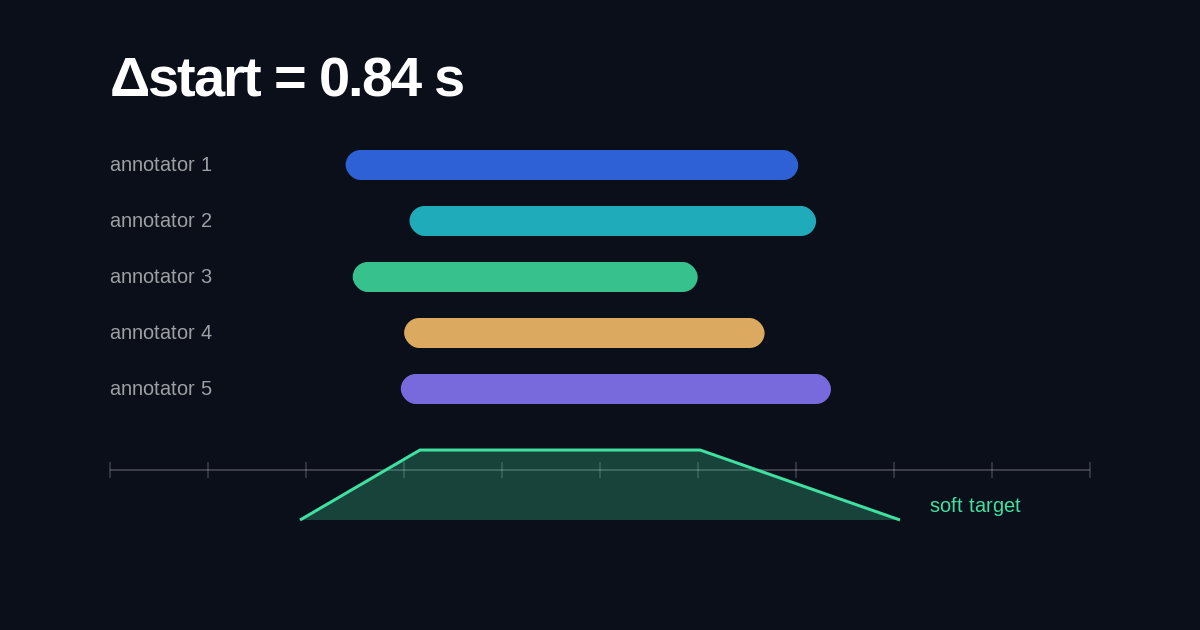
We asked five people to mark where the same moment starts. The median disagreement was 0.84 seconds, larger than the improvement most papers report over their baselines. Here is what we learned about boundary ambiguity, and why every number we publish now uses soft IoU.
 Mei Takahashi, Research Scientist
· 8 min read
Moment retrieval benchmarks share an assumption so basic that it is rarely stated: for each query, there is one correct time range. A model predicts a range, we compute its intersection-over-union with the annotated range, and if the IoU is above 0.5 (or 0.7), it counts as a hit. Leaderboards are built on that test.
When we designed HETKI, we wanted to know how much that single range could be trusted. So before writing guidelines, we ran a small experiment that turned into the preprint Where Does a Moment Start?
The experiment
We took 2,000 queries written by professional editors against licensed stock clips, and had five annotators independently mark the matching range for each. All five were experienced; all used vf-annotate with frame stepping; none could see the others’ marks. They were paid hourly rather than per item, so nobody had a reason to rush.
The results:
| Boundary | Median disagreement | 90th percentile |
|---|---|---|
| Start | 0.84 s | 3.10 s |
| End | 1.31 s | 4.65 s |
Here “disagreement” is the median absolute difference between an annotator’s boundary and the median of the other four. For a typical HETKI moment of about four seconds, a start disagreement of 0.84 s is enough to move IoU by 0.15 or more, which is exactly the size of the gains reported between competing methods on many public benchmarks.
Where people disagree
Disagreement is not uniform. It depends heavily on the kind of query.
- Discrete events (“the door slams”, “a bird lands on the railing”) are easy. Annotators agree within a few frames.
- Actions with a preparation phase (“he throws the ball”) split people. Does the throw start with the wind-up or the release? Both answers are defensible.
- Gradual changes (“the light turns golden”, “slow push-in on the face”) are the hardest. There is no single frame where a sunset becomes golden. The 90th-percentile disagreement for this group exceeded six seconds.
- Ends are worse than starts in almost every category. People notice when something begins; they are much less sure when it is over.
Annotators were not careless. When we showed them each other’s marks, they usually agreed that the others were also reasonable. The ambiguity is in the language and the footage, not the people.
If five careful people disagree by a second, a leaderboard that separates methods by half a second is measuring noise.
What it does to rankings
We re-evaluated six published moment retrieval methods on two public benchmarks, using our five-annotator ranges as alternative ground truths. For each method we computed R@1 at IoU 0.5 against each annotator in turn. The ranking of the six methods changed depending on which annotator was treated as truth in 41% of the pairwise comparisons. Two methods whose published numbers differ by 1.9 points swapped places three times out of five.
We are not saying those methods are equally good. We are saying the benchmark cannot tell, and that confidence intervals should be wider than they usually are.
Soft IoU
The fix we adopted is small. Instead of one range per query, HETKI stores three independent annotations (five for the test subset used in the paper). We build a soft target: for each instant, the fraction of annotators who included it. A prediction’s soft IoU is the sum of the target values inside the predicted range, divided by the length of the predicted range plus the target mass that falls outside it.
def soft_iou(pred, annots, clip_len, step=0.04):
    t = np.arange(0.0, clip_len, step)
    target = np.mean([(a0 <= t) & (t < a1) for a0, a1 in annots], axis=0)
    inside = (pred[0] <= t) & (t < pred[1])
    inter = target[inside].sum()
    union = inside.sum() + target[~inside].sum()
    return inter / max(union, 1e-9)
A prediction that covers the part everyone agrees on scores well; one that covers only the region a single annotator included scores less, but not zero. It degrades to ordinary IoU when annotators agree perfectly. The reference implementation is in hetki-eval, along with bootstrap confidence intervals over queries.
What changed in our own work
Three things. First, every number we publish now includes soft IoU and a 95% confidence interval alongside the traditional R@K figures. Second, our annotation guidelines say explicitly how to handle preparation phases and gradual changes, which reduced start disagreement on new annotations by about a third. Third, and most useful in practice: when moment search returns a result for a gradual query, it now pads the preview start by up to a second. Editors told us they would rather see the lead-in than miss it.
We presented this work at the November meetup, and the discussion afterwards was the best part. If you run a benchmark and want to test it for boundary ambiguity, we are happy to share our protocol and annotation tooling. Write to us through the contact page.
Research Scientist, Evaluation. Designs the benchmarks the rest of the lab is graded on, including HETKI. Moved to Helsinki for the job and stayed for the sauna.