
We teach machines to find the exact moment.
We are the lab behind VideoFinder moment search: twelve researchers and engineers in Helsinki working on video–language retrieval, motion understanding and speech alignment — and publishing the models, tools and benchmarks we build along the way.
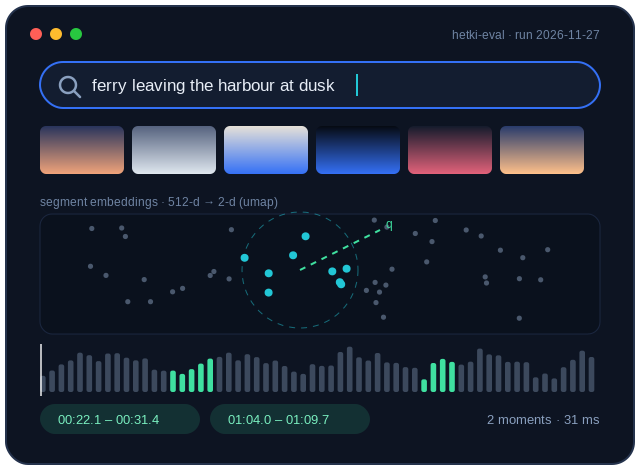

Search inside a video, right here
“A winter day at the Helsinki lab” is four minutes long. Ask for something that is said or something that is seen, and the demo returns time ranges, a heat-map on the timeline and the evidence behind each match.


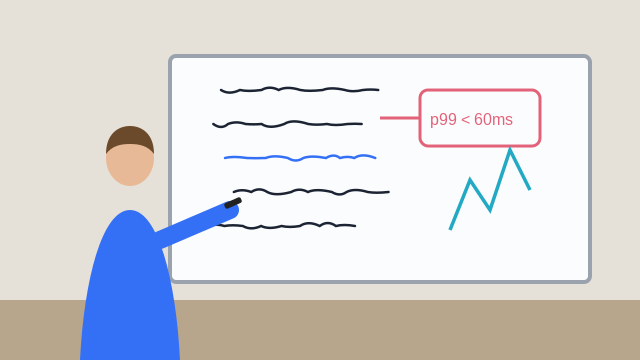
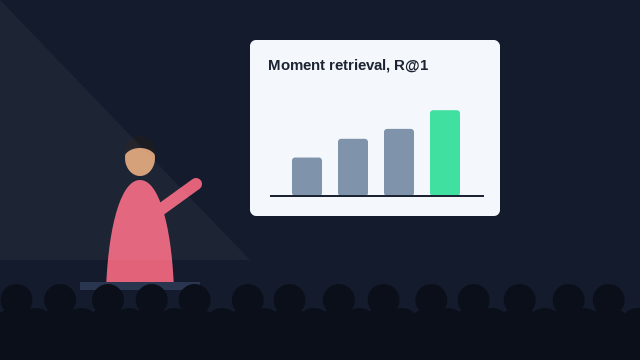

Moments
Enable JavaScript to try the search. The transcript is below.
Transcript
This toy scores 21 segments with keywords, synonyms and IDF weights, entirely in your browser. Production moment search uses learned embeddings over 1.1 billion half-second segments — here is how that works.
What we work on
Six threads, one goal: when an editor describes a moment, find it — in any language, in any of 40 million clips, in well under a tenth of a second.
Moment retrieval
Natural-language search that returns time ranges, not files. Late-interaction scoring over half-second segments, merged into moments and ranked at billion-segment scale.
Motion & camera understanding
Descriptors that separate camera moves from subject motion. A single frame can’t tell a push-in from a pull-out; our models look across time.
Speech & alignment
Frame-accurate alignment between what is said and what is shown, across variable frame rates, edit lists and nine languages including Finnish.
Efficient inference
Distillation and int8 quantisation so that indexing 40 million clips runs on commodity CPUs instead of a GPU fleet.
Evaluation & benchmarks
Benchmarks that measure what editors actually need, including boundary ambiguity: humans rarely agree on exactly where a moment starts.
Responsible data
Licensed footage from consenting creators, documented annotation pay, and a removal process for anyone who appears in our datasets.
Fresh from the lab
Technical reports, preprints and dataset papers. Every one comes with BibTeX, and most with code.
Segment-Level Late Interaction for Moment Retrieval at Billion Scale
Aino Lehtovaara, Mikko Rantasalo, Sanna Kivimäki, Tomasz Wierzba
Abstract & BibTeX →Motion Tokens: Disentangling Camera and Subject Motion from Dense Optical Flow
Elias Nordqvist, Sanna Kivimäki, Hanna Øvergaard
Abstract & BibTeX →HETKI: A Multilingual Benchmark for Natural-Language Moment Retrieval in Licensed Stock Video
Mei Takahashi, Lotta Haapanen, Aino Lehtovaara, Jussi Pelkonen
Abstract & BibTeX →Engineering notes
Long-form posts on what worked, what didn’t and what we measured.
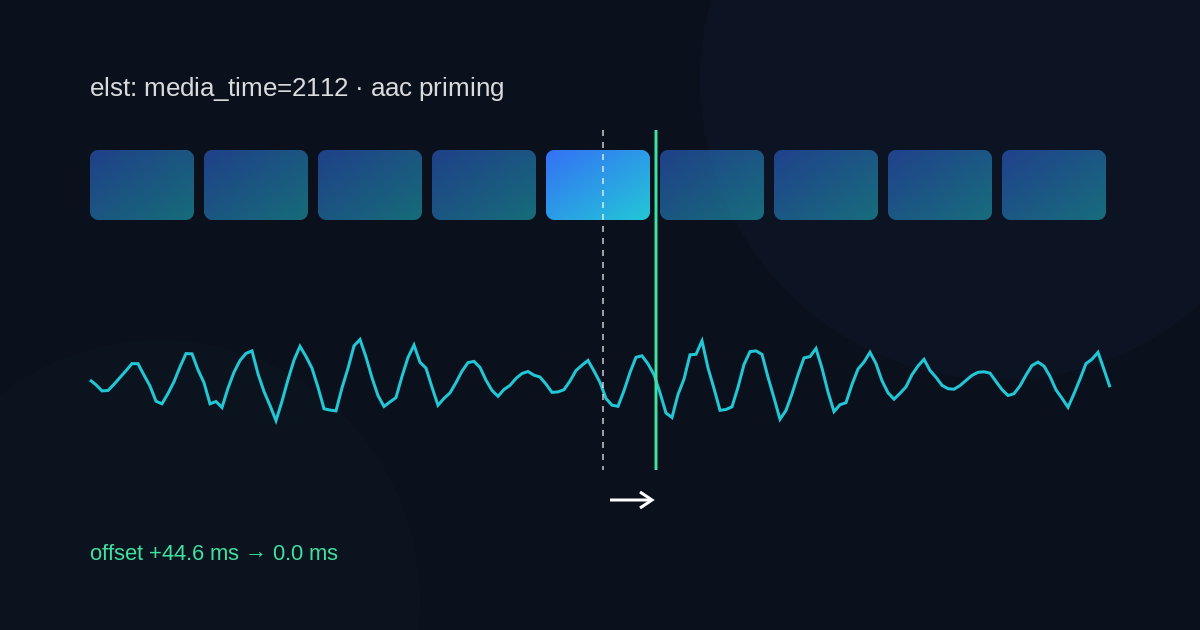
Your timestamps are lying: aligning speech to shots within 25 ms
A third of uploads have audio and video that disagree by more than a frame. Most of the blame goes to containers, not models. Here is how sarana rebuilds the real timeline.
 Jussi Pelkonen · 18 Nov 2026 · 9 min read
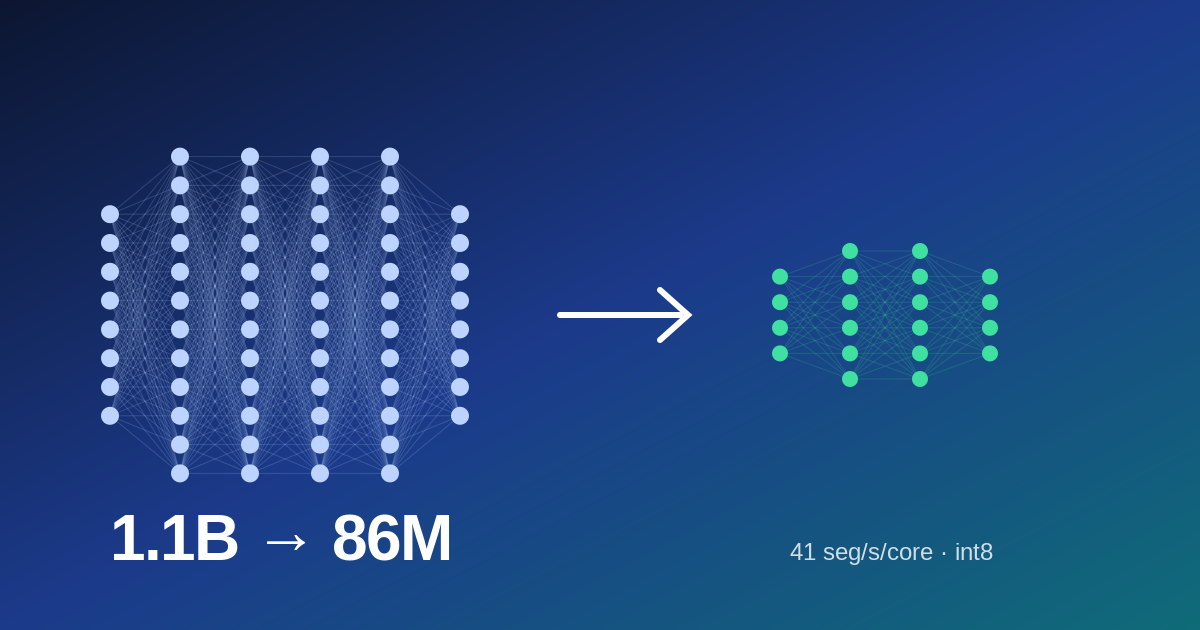
Fourteen times cheaper: distilling our moment encoder for CPU indexing
How we shrank a 1.1B-parameter video–text encoder to 86M parameters, what broke when we quantised it, and why temporal information was the first thing to go.
Priya Raghunathan · 29 Oct 2026 · 10 min read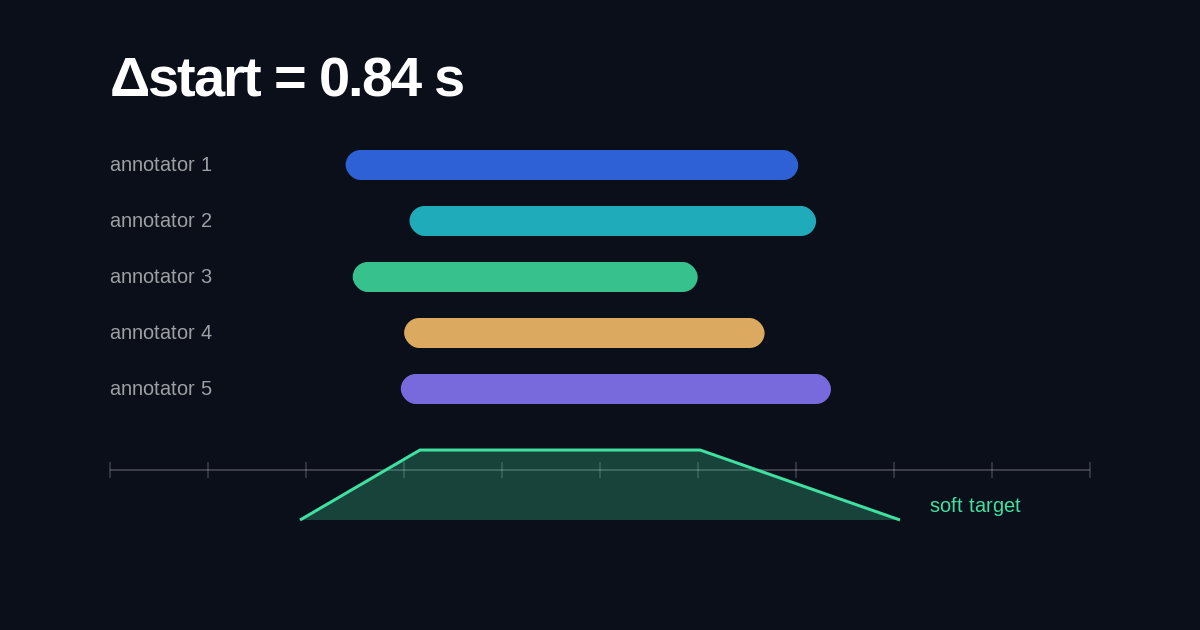
Nobody agrees where a moment starts — so we stopped pretending
Five annotators, 2,000 queries and a median disagreement of 0.84 seconds. What boundary ambiguity does to leaderboards, and the soft-IoU metric we now report everywhere.
 Mei Takahashi · 30 Sept 2026 · 8 min read









Twelve people, eight countries, one sauna
Researchers, engineers and annotators who moved to Helsinki for the work — and a few who were already here.
Helsinki Video ML Meetup #12: Winter edition: demos & glögi
17:00–21:00 at VideoFinder Research, Lumikonkatu 12 B. With Priya Raghunathan on “Live: indexing an hour of video on one CPU core” and Mei Takahashi on “HETKI 1.1 results and the 2027 challenge”, plus open demo tables.
We’re hiring in Helsinki
4 open roles across research and engineering. Salary ranges on every posting, relocation support, and a share of the cluster for your own questions.